CSLB Quick Facts

License required for jobs over
$1,000
Minimum contractor bond
$25,000
Journey-level experience
4 years
Current exam passing scores
School-observed: 65% for Law & Business and 63% to 71% for trade exams; CSLB does not publish fixed passing scores

The CSLB oversees 46 contractor classifications in California.

Free

Free Practice Exam

Try a 40-question practice exam plus 14-day course access, no cost, no commitment.

99% first-time pass rate. 100% Money-Back Guarantee

Need Help?

Start Your Contracting Business

From license to incorporation, we help you handle the paperwork so you can focus on the work.

800-809-6463

Become a Licensed C-7 Low Voltage Systems Contractor

The C-7 Low Voltage Systems license is the way into California's booming smart-building and connectivity market, structured cabling, security cameras, sound, and data, all under one classification.

View Exam Prep Programs

Requirements

Minimum age
18+ is CSLB's normal applicant path. A minor may qualify only after a court appoints a guardian (BPC §7065.5)
Experience required
4 full-time-equivalent years of journey-level experience within the past 10 years; CSLB prorates part-time work
Contractor bond
$25,000

About the Exam

Exam format
2 parts (Law & Business + Trade)
Law & Business exam
115 questions
School-observed scores
65% Law / 67% Trade; not published as fixed by CSLB
Application fee
$450

License renews every 2 years. Governing code: CCR §832.07

About this classification

What does a C-7 Low Voltage Systems contractor do?

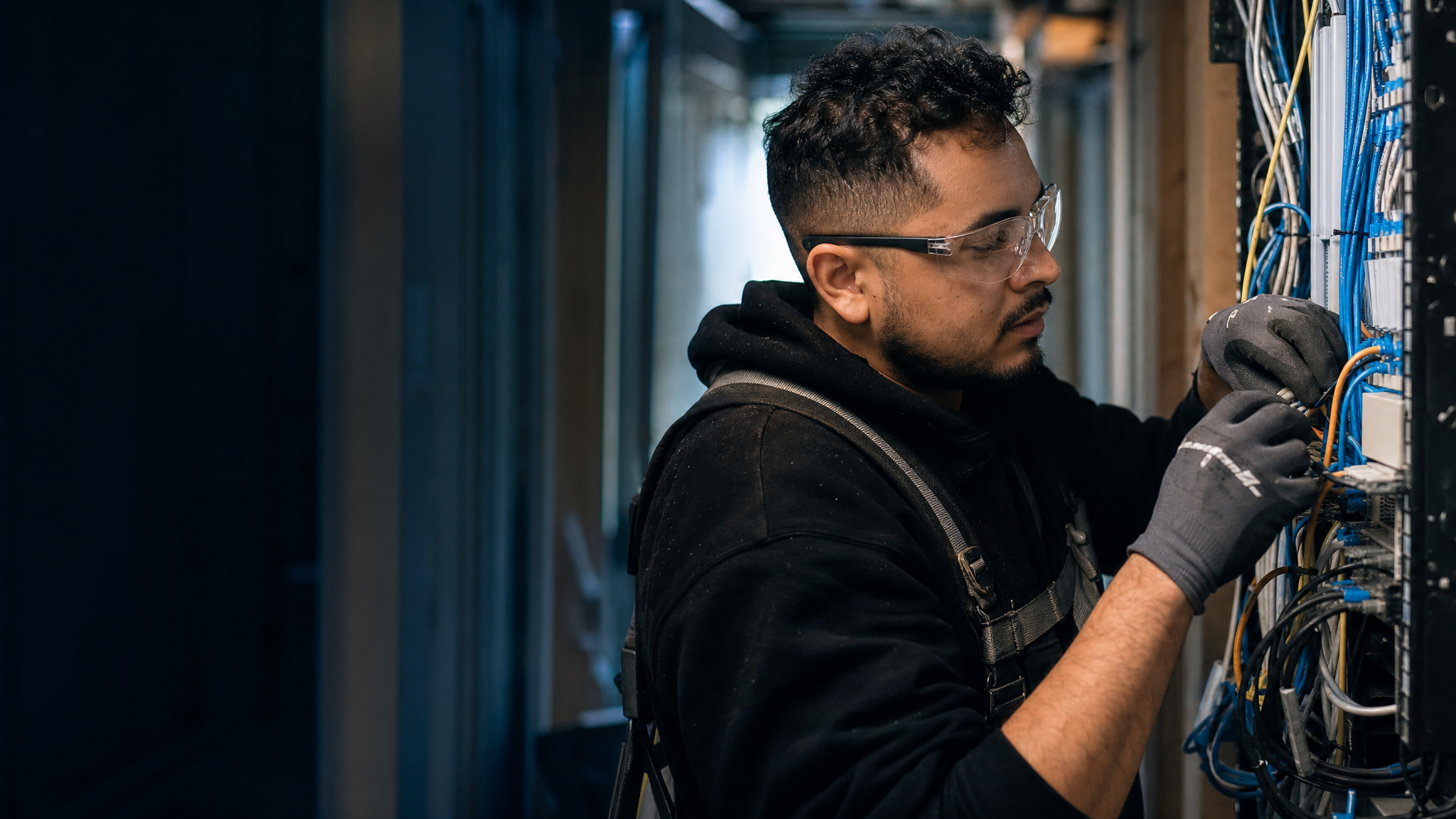
A C-7 Low Voltage Systems Contractor installs and services communication and low-voltage systems that are energy-limited and do not exceed 91 volts, phone, data, video, sound, and signaling. This license cannot perform line-voltage (high-voltage) electrical work.

Per California Code of Regulations (Title 16, §832.07), a C-7 contractor installs, services, and maintains telephone, sound, intercom, CATV, video, satellite, instrumentation, temperature-control, and low-voltage landscape-lighting systems. The defining boundary is the 91-volt energy-limited ceiling.

The C-7 is the standard entry point for technicians moving into the connected-building trades. It absorbed the former D-5 Communication Equipment classification, and demand is climbing with structured wiring, building automation, and access-control work across commercial and residential projects.

Official source: CSLB C-7 classification · CSLB fee schedule Last reviewed: March 2026

Scope of work

  • Structured cabling, telephone, data, and coaxial
  • CAT5e/CAT6 network and Ethernet runs
  • CCTV and security camera systems
  • Sound, intercom, and public-address systems
  • Satellite and CATV/video distribution
  • Instrumentation and temperature-control wiring
  • Low-voltage landscape lighting
  • Building-automation and signaling cabling (energy-limited)

High-demand specialties

  • Smart Buildings, Automation, sensors, and IoT cabling for commercial projects
  • Security & Surveillance, CCTV, access-control wiring, and camera networks
  • Structured Cabling, Data-center and office network infrastructure
  • Audio / Video, Distributed sound, conference rooms, and home theater

Important notes

  • A C-7 contractor is limited to systems that are energy-limited and do not exceed 91 volts, line-voltage (high-voltage) work requires a C-10.
  • Low-voltage fire alarm is excluded from the C-7, fire alarm wiring falls under the C-10, and fire-protection suppression systems fall under the C-16.
  • EV charging and the high-voltage side of solar are line-voltage work, a C-7 may handle data and low-voltage monitoring runs but cannot wire the power side.
  • Projects over $1,000 (labor + materials) require a license, and workers' compensation coverage is required once you have employees; sole owners with no employees may file an exemption (BPC §7125(b)).

The CSLB exam

What's on the C-7 Low Voltage Systems exam?

California requires you to pass a two-part CSLB exam: the Law & Business exam (the same for every classification) and the C-7 Low Voltage Systems trade exam. CSLS has observed scores of 65% for Law & Business and 67% for the C-7 trade exam. CSLB does not publish fixed passing scores and may vary them by exam version.

1

Law & Business

Same for all classifications

  • 115 questions, multiple choice, computer-based
  • 3.5 hours allotted
  • Topics: California contractor law, business management, safety, estimating, project management
2

C-7 Trade Exam

Low Voltage Systems-specific

  • about 100 questions, multiple choice, computer-based
  • 3.5 hours allotted
  • Topics: low-voltage theory, structured cabling, signal systems, grounding and bonding, codes and standards, blueprints, system testing

How to Get Your C-7 Low Voltage Systems License

Step 1

Qualify

18+ is CSLB's normal applicant path. A minor may qualify only after a court appoints a guardian (BPC §7065.5). You also need a valid SSN/ITIN and 4 full-time-equivalent years of journey-level low-voltage systems experience within the past 10 years; CSLB prorates part-time work. Up to 3 years may be substituted with approved education or apprenticeship.

Step 2

Apply to CSLB

Submit your application, get fingerprinted, and pay the $450 application fee. Processing times vary; check the CSLB's current processing times.

Step 3

Study & Prepare

Prepare for both exam parts, on your own or with a CSLS exam prep program. 99% of CSLS students pass on their first try, backed by our 100% Money-Back Guarantee.

Compare programs
Step 4

Pass the Exam

Two parts: Law & Business (115q, 3.5 hrs) + C-7 Trade. Multiple choice, computer-based. CSLS has observed scores of 65% Law & Business / 67% C-7 Trade; CSLB does not publish fixed passing scores and may vary them by exam version.

Step 5

Get Licensed

Post your $25,000 contractor bond, pay the $200 license fee, and receive your C-7 license. You're officially in business.

Career outlook

Why get your C-7 Low Voltage Systems license?

$55K–$85K

Typical CA Tech Range

$60K–$130K+

Owner / Contractor Range

99%

First-Time Pass Rate

Growing smart-building demand

Low-voltage technicians in California typically earn in the $55,000–$85,000 range as employees. Smart buildings, EV-charger data monitoring, and solar-system communications are pushing demand for structured cabling and signaling work across commercial and residential construction.

A practical entry point

The C-7 is the most common starting license for technicians entering the connected-building trades. Many holders later add a C-10 to take on line-voltage work, while others specialize in security, audio/video, or building automation.

Premium earning potential

Licensed C-7 contractors running their own businesses commonly earn $60,000–$130,000 or more, depending on niche and region. The license is legally required for projects over $1,000, a competitive moat that opens larger commercial security and cabling contracts.

Wage data: U.S. Bureau of Labor Statistics (OES) and California EDD.

Exam Prep Programs

Compare C-7 Low Voltage Systems Exam Prep Programs

Every program prepares you for the required CSLB exam for C-7 Low Voltage Systems. Our 99% first-time pass rate is backed by the 100% Money-Back Guarantee on eligible programs.

Feature-by-feature comparison of all four CSLS exam prep programs
Features Most Popular All-Inclusive C-7 Low Voltage Systems $1,195.00 Value: $2,500 Live Online C-7 Low Voltage Systems $695.00 Value: $995 Crash Course C-7 Low Voltage Systems $495.00 Value: $695 Home Study C-7 Low Voltage Systems $295.00 Value: $395
Best For Comprehensive prep with maximum support Remote learners wanting live instruction Experienced pros with an exam date soon Self-directed independent learners
Law & Business Classes 4 Classes + Full-Day Review 4 Live Online + Review Full-Day Review Only Not included
Trade Math Training 30-Day Interactive + Review Online Video Review 14-Day Crash Course Not included
Test-Taking Skills Seminar 1-Day In-Person 1-Day Online Not included Not included
Law & Business Materials Online; binder add-on available Online; binder add-on available Online; binder add-on available Online; binder add-on available
Trade-Specific Materials Online; binder add-on available Online; binder add-on available Online; binder add-on available Online; binder add-on available
Study Materials Full Online Suite Online Materials + Audio/Video Online + Audio/Video Online + Audio
Online Videos Full Suite: L&B, Trade, H&S, Math Audio + H&S + Math Videos Audio + H&S + Math Videos L&B Audio + H&S Video
Law & Business Practice Exams 6 Months 2 Months 30 Days 30 Days
Trade Practice Exams 6 Months 2 Months 30 Days 30 Days
School Location Access 25+ Locations 25+ Locations 25+ Locations Self-Study Only
Application Assistance Preparation & Review Review Only Review Only Not included
Money-Back Guarantee Included Included Included Not included
Bond Fee Discount 50% off first-year bond, up to $120 Not included Not included Not included
Retail Value $2,500 $995 $695 $395
Choose a program Get All-Inclusive Get Live Online Get Crash Course Get Home Study

Not sure which fits? Call 800-809-6463. Prices and inclusions are subject to change.

Labor Day 2026 Contractor License Exam Prep Bundle promotion for General A, B, B-2, all other trades, and Spanish programs.

Labor Day

Labor Day Promo 2026

$1,449.00 $795.00

Offer ends in

Days
Hours
Min
Sec

This offer has ended.

What our Low Voltage Systems students say

Free Resources

Try a free C-7 Low Voltage Systems practice exam

Test your knowledge with a free 40-question practice exam and get 14 days of online access.
No credit card required.

Common Questions

C-7 Low Voltage Systems license FAQ

The C-7 (Low Voltage Systems) is limited to energy-limited systems that do not exceed 91 volts, phone, data, video, sound, and signaling. The C-10 (Electrical) covers all voltage levels, high and low, so a C-10 can perform all C-7 work but a C-7 cannot do line-voltage electrical. If your work is wiring panels, lighting circuits, or branch circuits, you need the C-10; if it's cabling and low-voltage systems, the C-7 fits.
No. Low-voltage fire alarm wiring is specifically excluded from the C-7 classification, that work falls under the C-10. The C-7 covers security, CCTV, sound, data, and signaling, but not fire alarm. Fire-protection suppression systems (sprinklers) are a separate trade entirely under the C-16.
A C-7 can install the low-voltage and data side, monitoring, communications, and signaling runs, but cannot wire the line-voltage power side of an EV charger or solar PV system. Those connections exceed 91 volts and require a C-10. Many low-voltage contractors add a C-10 to take on the full installation.
Plan on roughly $885 in state and processing costs before exam prep: about $450 for the application (both exams bundled), $200 for initial license issuance, around $150 for the first year's premium on your $25,000 bond, and about $85 for fingerprinting. Renewal and any business insurance are separate.
From application to license-in-hand is typically 2–4 months. That includes CSLB processing (2–4 weeks), scheduling and passing both exams, and posting your $25,000 bond. With CSLS exam prep, most students are exam-ready in 4–6 weeks.
4 full-time-equivalent years of journey-level low-voltage systems experience within the past 10 years; CSLB prorates part-time work. Qualifying work may be as a journeyperson, foreperson, supervising employee, contractor, or owner-builder. Up to three years can be satisfied with approved technical training, apprenticeship, or education.
The C-7 trade exam is multiple-choice and covers low-voltage theory, structured cabling, signal systems, grounding and bonding, and applicable codes. You need the current version-specific CSLB passing score to pass. With CSLS exam prep, 99% of students pass on their first attempt, backed by our 100% Money-Back Guarantee.
CSLB evaluates reciprocity case-by-case (BPC §7065.4) and may waive the C-7 trade exam if your out-of-state license has been in good standing for the past five years; CSLB names no fixed list of reciprocal states. You still must pass the California Law and Business exam and meet all application requirements. CSLS can help you confirm whether your out-of-state license qualifies.

Since 1985

40+ Years

200,000+

Students Licensed

99% Pass Rate

First-Time

100% Money-Back Guarantee

Tuition Refund

Ready to get your C-7 Low Voltage Systems license?

99% of our students pass on the first try, backed by our 100% Money-Back Guarantee. Your low voltage systems license is closer than you think.

Select Your Trade Classification

Choose your CSLB classification to see exam prep programs

Not sure? Call 800-809-6463, we'll help you choose.